By: Aubrey Charron, BSBA, SSGBP
Those who know me can attest: I may live in North Carolina now, but Atlanta, Georgia is my home. I was born at Atlanta’s Northside Hospital, grew up going to Children’s Healthcare of Atlanta when I needed medical assistance, and moved from my childhood Atlanta home only to go to college at Georgia Tech a mere nine miles down the road. My junior year at Tech and desire to pursue a career in Healthcare Administration coincided beautifully with the opening of Children’s brand new 2 million-square-foot Arthur M. Blank Hospital. I jumped at the chance to get an internship and soon joined the Transition team with no knowledge that Transition meant anything more than moving 200+ patients on September 29, 2024. Little did I know that my time as an intern would leave me with lessons that shape the way I approach Transition and Activation work today.
As it turns out, Patient Move is only the tiniest fraction of Transition and Activation work. There were 10 years of planning, monitoring construction schedules, and mapping new workflows that went into opening the Arthur M. Blank Hospital before that September day finally came. I arrived to the Orientation & Training team in June 2024 after they themselves spent years identifying what would be New & Different and developing a curriculum to train thousands of staff members to those topics.
It’s now been two years since my summer with Children’s and one year since I embraced Transition and Activation Planning as my fulltime job. As I reflect, I’ve identified four lessons from my time as an intern that I use daily.
- Stay calm. Easier said than done. Any change is challenging, but a change that impacts your physical space, routines, staffing, technology, workflow, AND patient care is Herculean. While interning, I saw firsthand people’s fears about how they would work in a new building and sadness about leaving their beloved legacy space behind. I felt pressure to do my job perfectly, not wanting to add further stress to the Transition Team and hospital staff who were already navigating so much. At times, it felt like there was a storm of overwhelming angst with little margin for error around us.
Today, as a Yellow Bricker, I sometimes see that same high-pressure state with our clients – but in those moments, Yellow Brick thrives. Our job is to remain calm and clear-minded, walk with teams through uncertainty, and be aware of risks that may arise. We’re ready to help mitigate the stress from the storm. Whether we’re hopping on weekly touchpoints with clients, actively discussing risks on the Risk Register, or openly sharing project progress via dashboard metrics, Yellow Brick has all the tools and templates needed to get through challenging times successfully.
- Be flexible. I know – the type A in me cringed at those words, too, but it’s perhaps the single most important skill in Transition and Activation work. In the midst of preparing a hospital to open, you’ll face plenty of roadblocks along the way. I will never forget working one Saturday at Children’s where just about everything that could go wrong did go wrong: our computer system crashed, the catering order was half the size it should have been, and several volunteers did not show up. While my inner control freak was sounding alarm bells, my inner theatre kid told me that the show had to go on. We had to pivot. Flexibility is something I continue to work on, but now, I can genuinely say that one of my favorite parts of working for Yellow Brick is that each project constantly pushes us to think on our feet. No matter how much we refine our process or work towards the optimal Yellow Brick way, each project will always present new gaps and challenges that need to be filled. Our team stays flexible and is always ready to adapt.
- Be willing to do anything. Nobody wakes up in the morning hoping they’ll get to spend the day doing grunt work, but some days, the grunt work has be done. As an intern, one of my regular tasks was moving pallets of water bottles from the loading dock to the cafeteria for the staff that was in the building for training. As a Yellow Bricker, we’ll spend days taping up paper signs ahead of major milestone events. While neither of these tasks top my list for favorite responsibilities, it’s important to recognize that they have to get done. Someone has to do them. I’m a firm believer that Transition work is only successful when everyone checks their egos at the door. If you see an outstanding task, be the person to knock it out. A word of advice – Yellow Brick finds that tedious work is made exponentially better by putting on music and dancing while you complete the job. Trust us on this one!
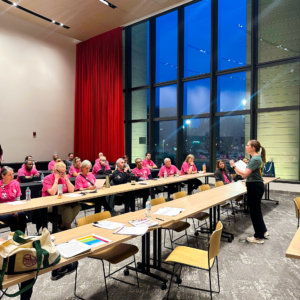
- Remember what an honor Transition work is. On the day of Children’s Patient Move, I cried more times than I could count. I knew what a big milestone this was for my beloved Atlanta community. We were doing something special. I cried with gratitude that I had the smallest piece in getting Children’s to where they were. I cried with joy for all the Atlanta kids that would be cared for in this amazing facility. I cried with pride for my city. The very next day, I messaged a handful of Yellow Brickers on LinkedIn, because I knew that Transition and Activation Planning was what I wanted to do with my career. During my first patient move on the Yellow Brick side, I cried just as much, with the same sense of gratitude and wonder to have taken part in something so special to another community. In all the moments that require us to stay calm, to be flexible, to do the tedious task, remember also what a privilege it is to be welcomed into another community and take part in each of these projects. I’ll never forget the awe I experienced during my first Patient Move, and I urge my fellow team members to always remember the first-move feeling, no matter how many times we’re lucky enough to do this.
I miss my home in Atlanta and the project that got me into this world, but I’m also thankful. I’m thankful for the lessons and experience Children’s gave me. I’m thankful for my new Yellow Brick community that encourages me to continue growing in this field. I’m thankful for the projects that have brought me to new cities. Atlanta will always be my home, but because of this work, so will Columbus, and Houston, and every city to come. I can’t wait to see what lesson Transition & Activation Planning teaches me next!